

Interview — At Étienne Russo’s, Paris Noir Comes to Life for One Night
- Victoria Di Cala (BC)

- Jun 30
- 5 min read
Étienne Russo poses with Paris Noir magazine. © NSS France Paris Noir, the first issue of the editorial project. © NSS France Launch evening for Paris Noir at Étienne Russo’s Paris apartment.
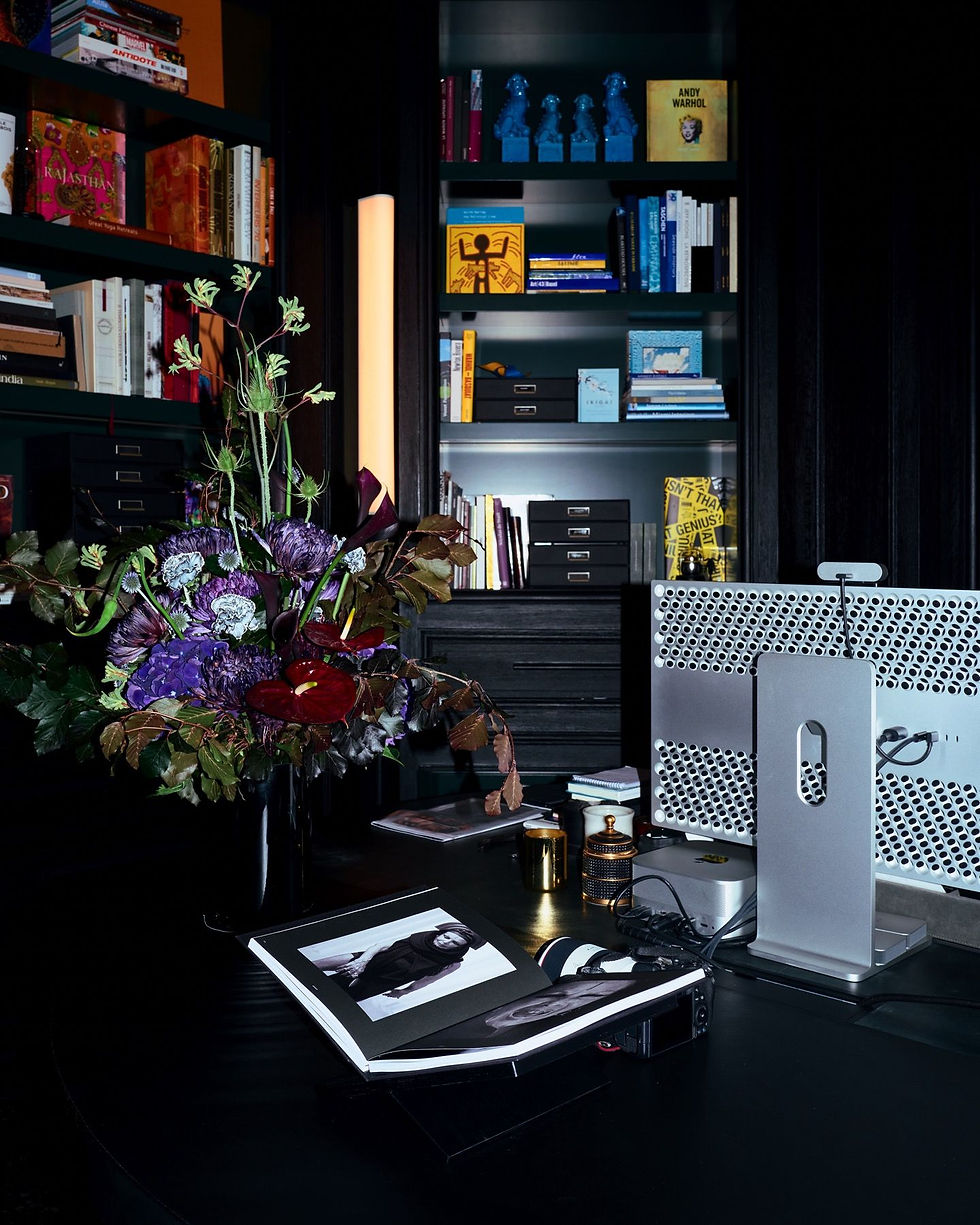
Launch evening for Paris Noir at Étienne Russo’s Paris apartment. ©NSS France
Invited by NSS France to the launch of Paris Noir, ETUU discovered far more than a new magazine. In his Paris apartment, Étienne Russo envisioned an evening that reflected his own sensibility: intimate, emotionally charged, and dedicated to celebrating a new generation of creatives he is now committed to supporting.
Some invitations already feel like a statement of intent. To mark the release of Paris Noir, the latest chapter in NSS France’s editorial trilogy, Étienne Russo chose neither an art gallery nor a hôtel particulier or event venue. Instead, he opened the doors of his own Paris home.
It was a deliberate choice. A leading figure in contemporary scenography, renowned for creating spectacular settings for the world’s most prestigious fashion houses, Russo decided this time to invite guests into his own personal universe.
From the moment you step inside, the mood is unmistakable. The lighting is subdued, the soundtrack deliberately atmospheric, almost suspended in time, while conversations blend effortlessly with discreet musical notes in the background. More than a launch party, the apartment feels like a natural extension of the magazine itself.

«I wanted to do it here because it reflects who I am. In a way, it’s part of Paris Noir. I also wanted the music to be slightly dark—a late-night soundtrack, deeply atmospheric and emotional.
Like its host, the evening favours emotion over spectacle. Every detail seems carefully considered, inviting guests to linger, browse through the magazine, and engage in conversation in an intimate atmosphere, far removed from the usual frenzy of editorial launches.
A Creative Calling


For Paris Noir, Étienne Russo steps into the role of guest editor-in-chief for the very first time. It is unfamiliar territory for someone who has spent decades bringing other people’s visions to life rather than his own. When asked what convinced him to accept the project, his answer comes without hesitation.
«When it was offered to me, it immediately felt right. There’s so much about Paris that deserves to be revealed—through fashion and everything that defines the new generations. I wanted to shine a light on all of it.»
With Paris Noir, Russo is not interested in portraying a postcard version of Paris. Instead, his gaze turns towards a city in constant motion, shaped by the people who reinvent it every day.
The magazine deliberately moves away from familiar representations to explore a quieter, sometimes underground Paris, where fashion, art, creativity and contemporary culture exist in free dialogue. That vision is equally reflected in the personalities featured throughout its pages.
Another Vision of Paris
On the cover, Michèle Lamy appears as the obvious choice. Muse, producer, designer and Rick Owens’ longtime partner, she has embodied an artistic freedom that extends far beyond the boundaries of fashion for decades. Her portrait introduces a magazine that also gives space to figures who may no longer occupy the spotlight, yet whom Étienne Russo believes continue to represent an essential side of the French capital.
Among them is American photographer Spencer Tunick, whose monumental public installations occupy a prominent place within Paris Noir.
«I went back to people we don’t hear much about anymore. Spencer Tunick, for instance, whose installations I’ve always admired. There was also another very important theme: love. Love for Paris, but also love in a broader sense. I believe you can feel that throughout the magazine.»
Far from indulging in nostalgia, Paris Noir ultimately reads as a love letter to a multifaceted city where generations, cultures and different creative practices coexist.
Putting the Next Generation First

While Paris Noir pays tribute to one of the world's great creative capitals, its true focus lies elsewhere: on the people already shaping the Paris of tomorrow. From the outset, Étienne Russo explains that he saw the project as an opportunity to bring a new generation of creatives into the spotlight.
«I’ve reached a stage in my life where I want to put my experience at the service of younger people.»
It is a sentence that resonates like a manifesto. After spending decades working alongside some of the world's leading luxury houses through Villa Eugénie, the Belgian scenographer is now turning his attention to those just beginning to write their own stories. For him, Paris Noir was never meant to simply portray a city, but rather the women and men who give it its energy today.
«There was a very clear direction: finding the young people who are driving Paris forward. Even when they come from outside France, they contribute to the life of this city. That was truly the heart of the project.»
Throughout the magazine, emerging talents naturally converse with more established figures, creating a sensitive portrait of a constantly evolving Paris, where generations complement rather than oppose one another.
Returning to His Roots
This commitment to supporting young creatives is far more than a declaration of intent. It reaches back to the very beginning of Étienne Russo’s own career. Long before becoming one of fashion’s most influential scenographers, he helped launch the careers of several Belgian designers who would go on to become industry icons.
Today, he feels compelled to reconnect with that same spirit.
«I’m thinking about launching a new project dedicated to young creatives. I’d like to support them because they genuinely need it today.»
In many ways, it feels like coming full circle.
«I started out working with young Belgian designers such as Dries Van Noten and Walter Van Beirendonck. In the end, it’s a return to where it all began.»
Behind those words lies a new chapter in his career—one defined less by production than by transmission.
Keeping a Child’s Eye

Despite a career spent at the highest levels of international fashion, Étienne Russo insists that the curiosity that first inspired him has never faded. Asked what continues to surprise him today, his answer is immediate.
«I still have a child’s eyes. I’m constantly amazed by talented people. There’s so much happening in music, fashion and cinema... It makes me want to keep looking at the world as it is today.»
A world that he nonetheless recognises has become more fragile.
«We’re living through difficult times, but I still believe there’s room for optimism. And I want to reach out and share that.»
Perhaps no idea better captures the spirit of Paris Noir. More than a publication devoted to Paris, the magazine emerges as a meeting point where generations, disciplines and creative sensibilities converge. Throughout the evening, Étienne Russo’s apartment became the physical extension of that vision—a place where conversations, encounters and artistic expression flowed as freely as they do across the magazine’s pages.
In his debut as guest editor-in-chief, Russo has done more than publish a magazine about Paris. He has offered a heartfelt declaration of love to a city that, in his view, still belongs above all to those bold enough to reinvent it.
Contribution ans Interview by Rachel Ioussaïdene
Translation by Federica Mignacca


